Celebrate Correctness While Overlooking Understanding
Jun 07, 2026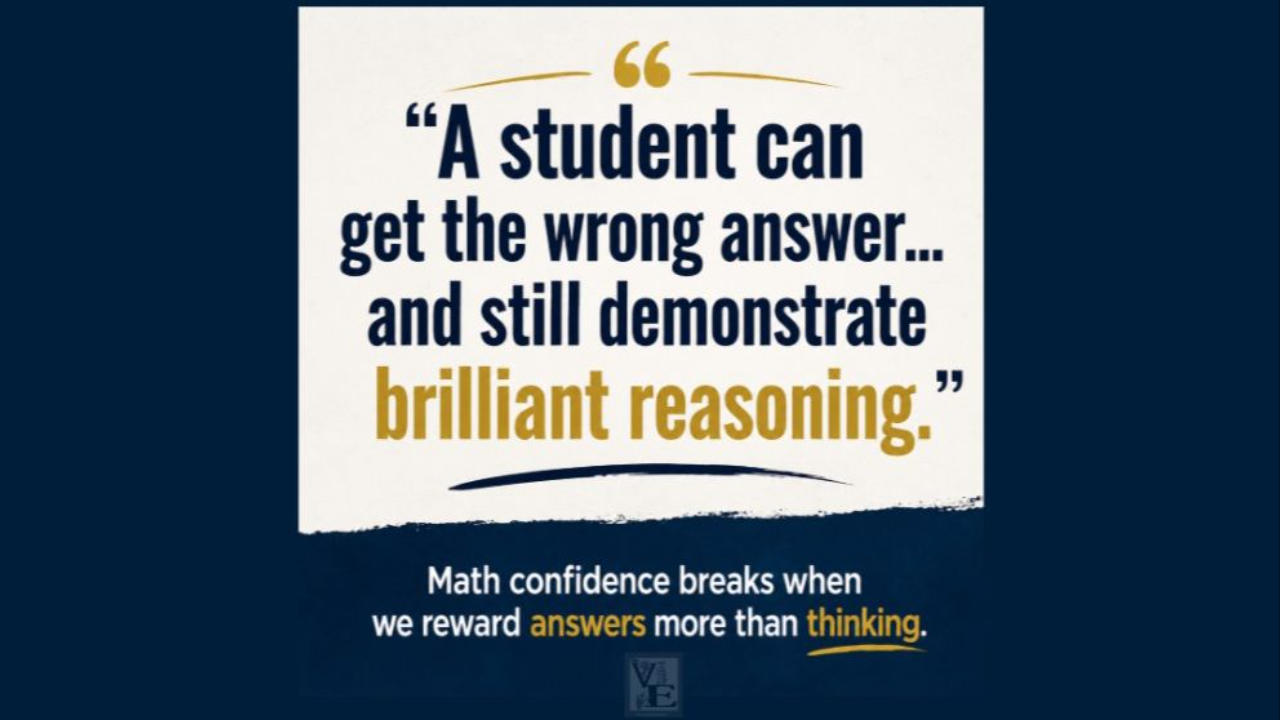
The biggest mistake happening in math classrooms isn’t always poor instruction.
Sometimes it’s what we unintentionally reward.
Too often, we celebrate correct answers while overlooking whether students actually understand how they got there.
And that’s where math confidence quietly begins to break.
Because a student can get the wrong answer and still demonstrate brilliant reasoning.
While another can get the right answer with little understanding at all.
That can be difficult to recognize,
because many of us were taught this way ourselves.
In many classrooms, correctness quietly becomes the goal instead of making sense of mathematics.
Before introducing strategies, tools, or interventions, we have to examine what we reinforce every day.
In previous posts, we’ve already discussed:
#1 Teaching procedures before understanding
#2 Speed becoming more important than thinking
#3 Mistakes becoming shameful instead of useful
#4 Teachers accidentally teaching helplessness
#5 Math feeling emotionally unsafe
Now here’s another hidden cause of math anxiety schools rarely discuss:
#6 Teachers Focus on Correct Answers More Than Student Thinking
When students believe math is only about “getting it right,”
they often stop exploring.
➡️ They stop questioning.
➡️ They stop explaining.
➡️ They stop taking risks.
Because math starts to feel like performance instead of understanding.
One question we ask too often:
“What’s the answer?”
But these questions change everything:
• How did you think about it?
• Why does that make sense?
• Can you prove it?
• What pattern do you notice?
• Can you solve it another way?
Those questions communicate something powerful:
👍 Your thinking matters.
👍 Your reasoning matters.
👍 Your process matters.
And that changes everything.
Math shifts:
From memorization → critical thinking
From performance → problem-solving
From fear → confidence
That transformation is exactly why I built a research-based math system designed to reduce math anxiety, strengthen reasoning, and create deeper mathematical conversations.
🎉 We’re getting closer to launch.
Follow along as we continue uncovering hidden causes of math anxiety, and how we can rebuild math confidence, independence, and critical thinking from the inside out.
Educators and Learning Coaches:
What question consistently gets your students to think deeper, explain more, or reveal their reasoning?
-G. Davis
theVirtualEducator.org